

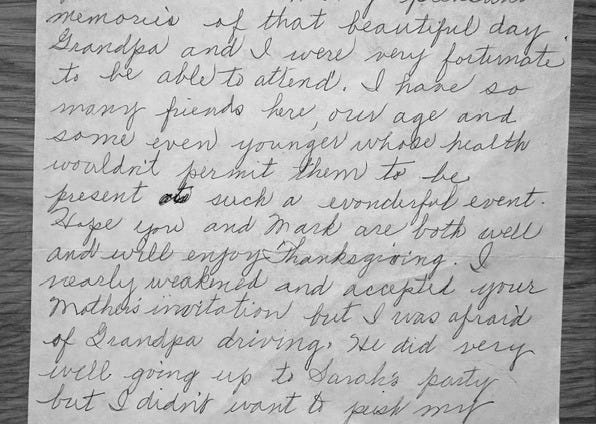
The other day, I savoured the final pages of Virginia Evans’s popular novel The Correspondent. Sybil, the protagonist, tells the reader her story through correspondence with many people: family, friends, famous writers and creators, and more. Some of the correspondence was by email, but much of it was by letter. It reminded me of my experiences of receiving, and sometimes writing and sending, handwritten letters. I am not sure there is anything more powerful than a handwritten letter and the ability to save the important ones from a life. Perhaps this is also significant, as I am at the point in my life when I am constantly sorting and deciding what to keep—mostly the letters and cards.
Because they are handwritten, the writer’s identity, expressed through their script, personality and voice, seems to jump off the page. One of my many handwritten treasures is a letter I received from my grandmother in her late eighties, just before she passed away. Two pages of her expressions of love for me, my new husband at the time, and my sister, all in her beautiful script, perfectly straight, with every letter masterfully formed, make me reminisce about her every time I come across them. I am sure her fine motor skills held up until the end, supported by her constant handwriting throughout her life.
Writing by hand rather than typing, although slower, helps the brain process what is written. My daughter used to handwrite all her university study notes because she found that writing the material or concepts further deepened her understanding. Handwriting can help build hand strength, which is now considered an indicator of long-term health.
Writing by hand forces the brain to think, not just record.
Where does this leave handwriting in an age of computers, tablets, typing, and now AI? This question feels especially important for children learning not only to form letters but also to connect them into sentences that express their thoughts and ideas.
It saddens me that cursive, or script—an older form of handwriting—now seems like hieroglyphics or a foreign language to many people under 35. Yet learning cursive provides direct access to hundreds of years of primary texts, including letters like my grandmother’s. Cursive, with its more natural, continuous motion, can also help beginning writers achieve smoother handwriting and avoid letter reversals. In my experience, if started at a young age, by five, it may be easier to teach script before print for both writing and reading.
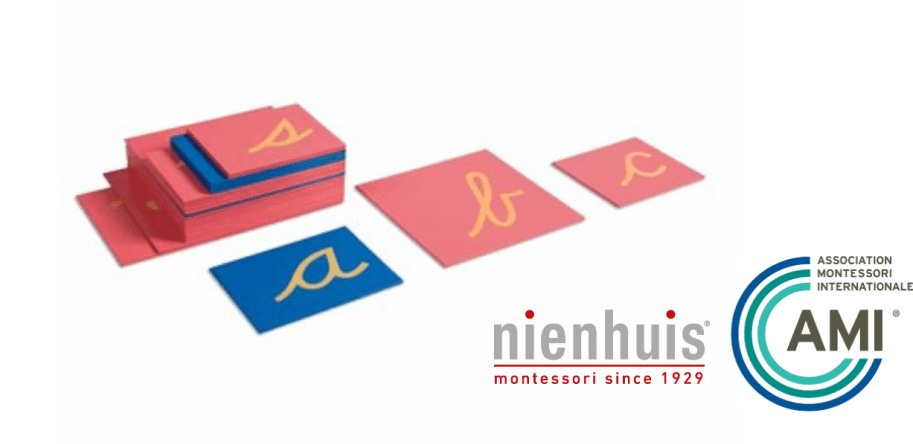
In Montessori, children learn to write before reading, giving them a physical experience of each letter and the sound it makes. “There is a more natural linking together of hand and mind in forming cursive letters… they are more easily imprinted in the child’s memory.” (Lillard, P. Montessori: A Modern Approach, p.128) This supports reading and writing and allows a natural flow of letters, rather than repeatedly picking up the pencil to form letters, words, and sentences. In a Montessori school, we often found that children came to our programmes with little or no experience of cursive writing, and parents or educators often cited a lack of interest. Admittedly, when helping a child learn cursive letterforms at 7, 8, or 9 years of age, after printing for a few years, I would not be that interested either. Teaching children the shapes of cursive letters at ages 3, 4, or 5 is much more effective and easier for them. That is when the window of interest is keen.
“The hand is the instrument of the mind.”
Maria Montessori, The 1946 London Lectures, p. 36
Writing by hand also requires fine-motor strength and coordination, so encourage children early on to use their thumb and index finger to form a pincer grip. This can initially be developed using puzzles with knobs, small tweezers, and picking up yummy peas and corn!
Personally, unless it helps with accessibility, keep children off digital technology until at least upper elementary (grades five or six), especially for writing and reading. They need to learn to write first, preferably cursive, and to read, while being read to from infancy. Ideally, children initially hear and learn the sounds of letters (not their names, as in the common alphabet song) that make words, and they also start forming them. Guiding a child to write in cursive first, since it uses a more natural hand movement, prevents letter reversals and supports reading cursive as well. Reading print will evolve out of writing cursive. Then, over time, with engaging, developmentally appropriate instruction, practice, and attention to all types of literacy, a child can often develop strong skills, including written expression.
With the prevalence of digital technology, voice commands, and keyboards, many people write about the importance of writing by hand, even as adults, like my grandmother. Although cognitive decline varies for each individual, I am sure her regular writing of letters to family and friends assisted with keeping her sharp until she passed away.
I believe writing and sending letters and cards to our grandchildren, nieces and nephews, parents, and grandparents can create a special connection and leave a lasting legacy through artefacts like my grandmother’s, along with the legacy of the skill.
Thanks for reading Educating Human Potential! Subscribe for free to receive new posts and support my work.
Lillard, Paula Polk, Montessori: A Modern Approach. Schocken, 1972
https://www.mic.qld.edu.au/wp-content/uploads/2025/05/Why-Cursive-Article.pdf
https://www.washingtonpost.com/wellness/2023/01/18/grip-strength-muscles-aging


